
Why does Nerdwallet redirect users to a "risky" service?
I thought I was signing up for financial advice, but I uncovered a whole lot more.

Last weekend, as I tried to figure out how to make my money stretch further and for longer, I googled a question that I already knew the answer to.
Of course, I knew that trying to pay off one credit card with another credit card was a bad idea. But after having used up my balance transfers to successfully pay off one card, I was trying to figure out how to shuffle my money around until I could finalize my divorce. 🙃
So, I did a search and Nerdwallet came up. It had paid to be featured on the results page for the question that I searched. But it had also used location data to convey a friendly local solution.
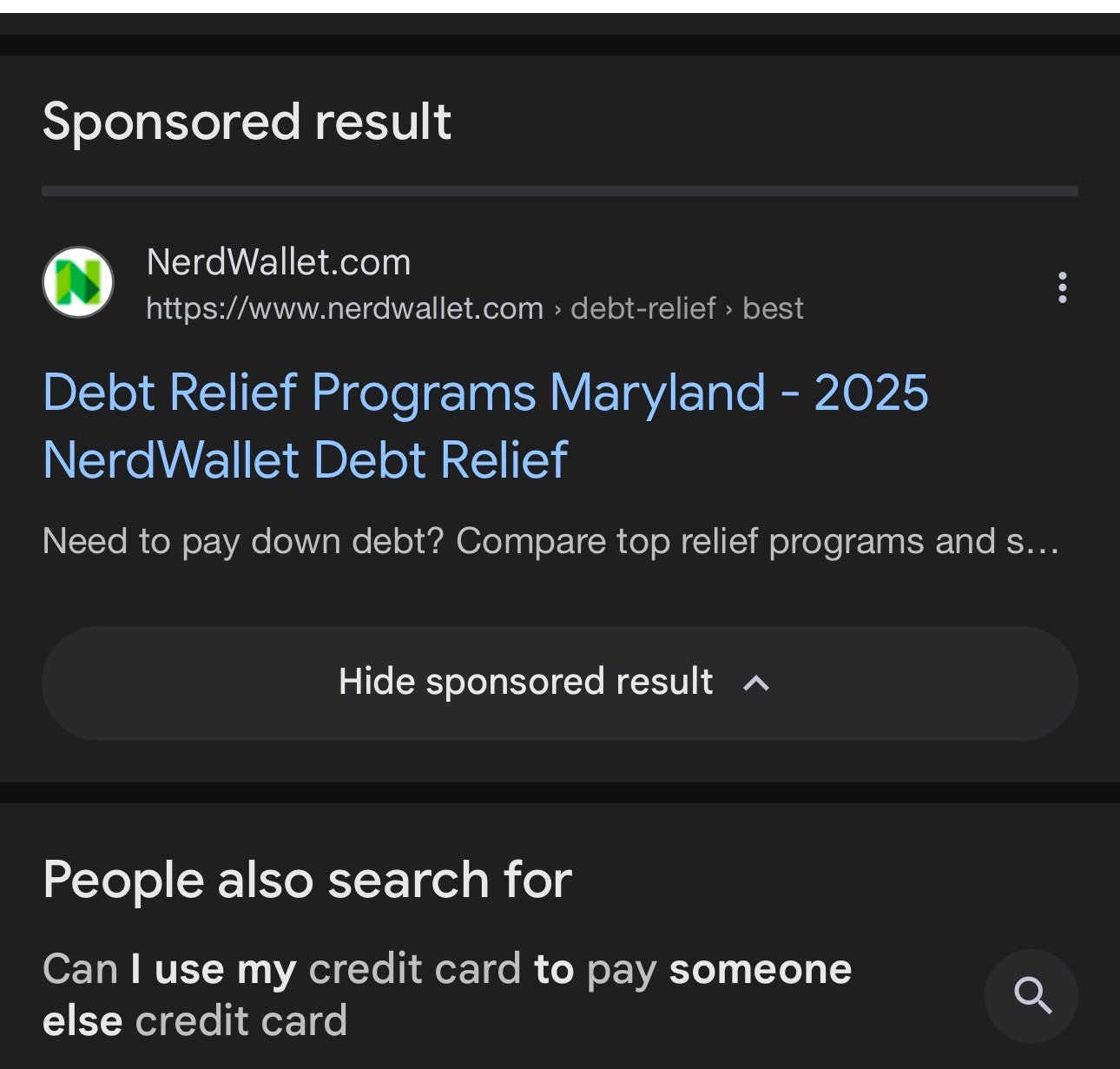
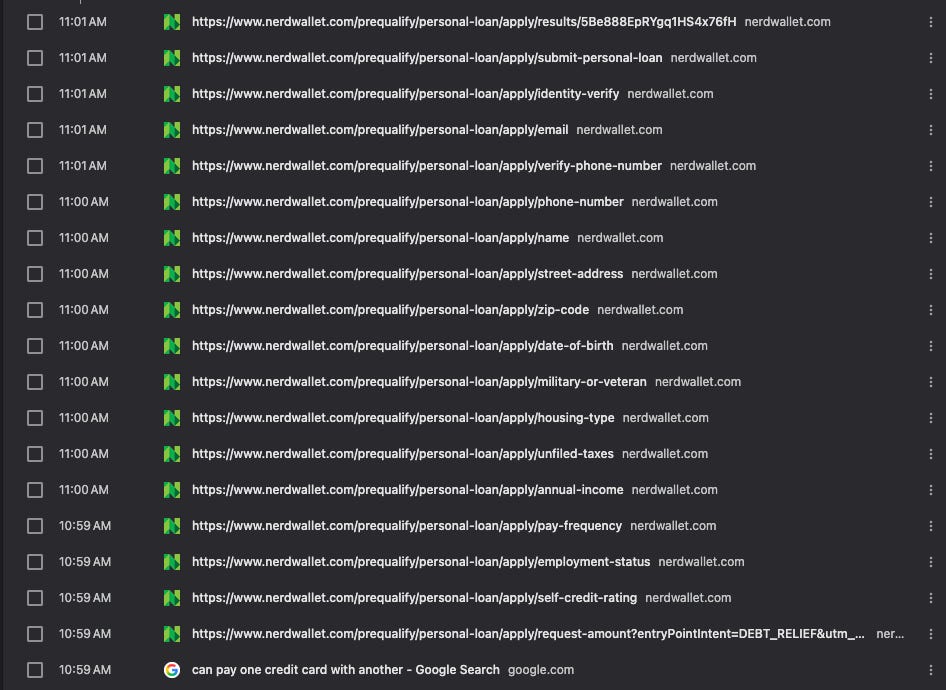
Clicking the sponsored link set off a series of data collection pages, which I gamely filled out because:
1) I was feeling pretty low and was hoping to find practical financial advice to help me get out of my mess; and
2) I was browsing all of this on my phone. So, I didn’t notice that the full URLs of the pages I was filling out were for a personal loan pre-qualification with one of their advertisers.
Nerdwallet Partner
Unfortunately, as soon as I clicked the last button on Nerdwallet, I knew I had fucked up.
“What?! You’re just redirecting me to your advertiser now?” I screamed internally as the page counted down the seconds.
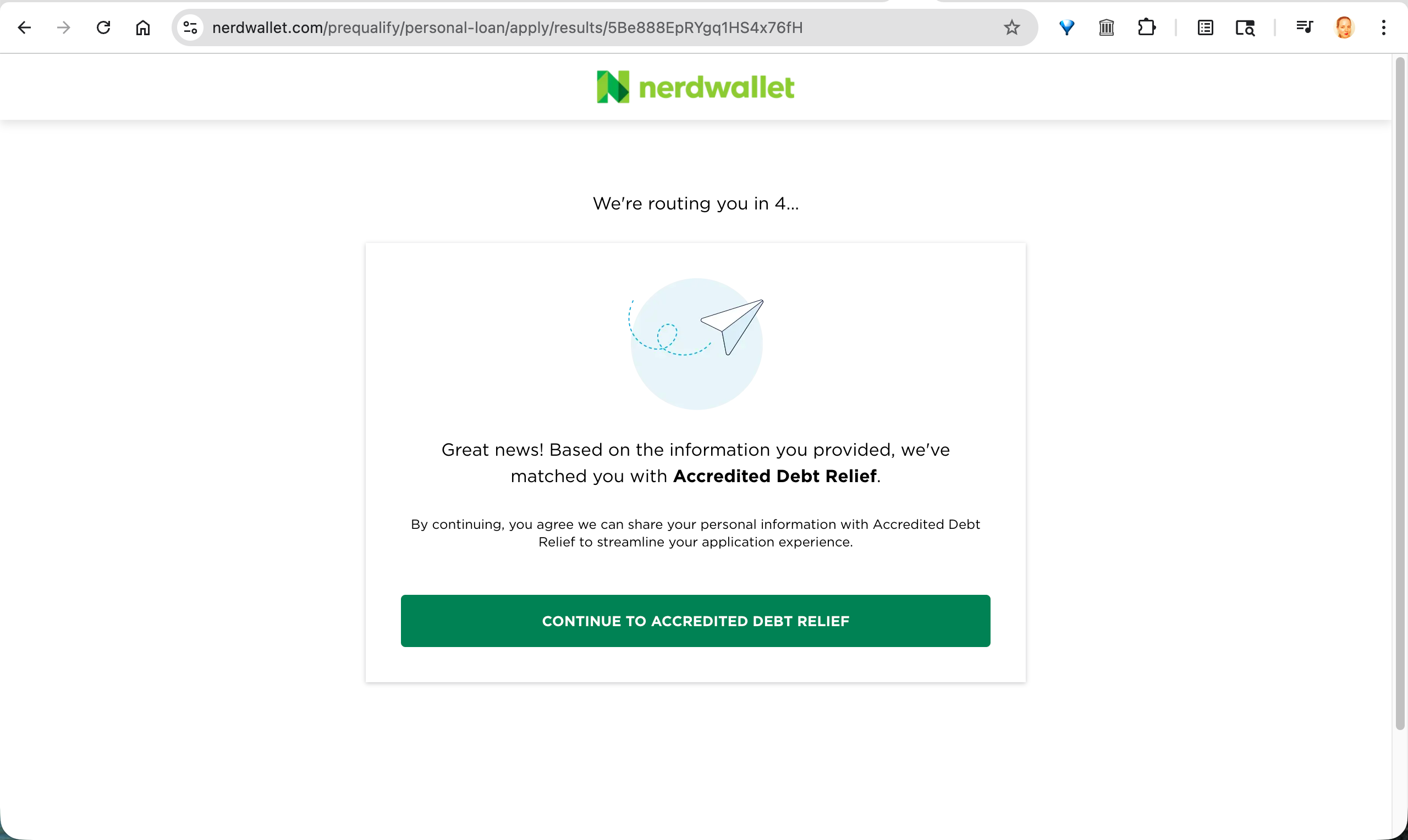
Nerdwallet’s customer journey spat me out at a co-branded page that quickly redirected to its partner Accredited Debt Relief (ADR), the debt resolution arm of the company Beyond Finance.
I don’t know what I was expecting after having filled out all of my personal details. But again, I was already feeling vulnerable because of my situation. Plus, I thought I was signing up for something from Nerdwallet.
They colored the button green for a reason.
Coupled with an instant redirect, the green button might as well have been a green light to Nerdwallet, who quickly gave away my info to another company without my clear consent.
I was given all of five seconds to agree to sharing my personal info and there was no way to opt out or decline.
TFW you’re redirected to a third-party website
As I apply for digital marketing and content management jobs day after day, I can’t help but notice the little details that go into making a marketing email or a landing page.
Likewise, when one is a consumer and trying to find ways to save money, one pays attention to the little ways that companies try to extract money from you, whether directly or by selling your info.
I was annoyed when I realized that clicking a radio button somehow indicated my consent.
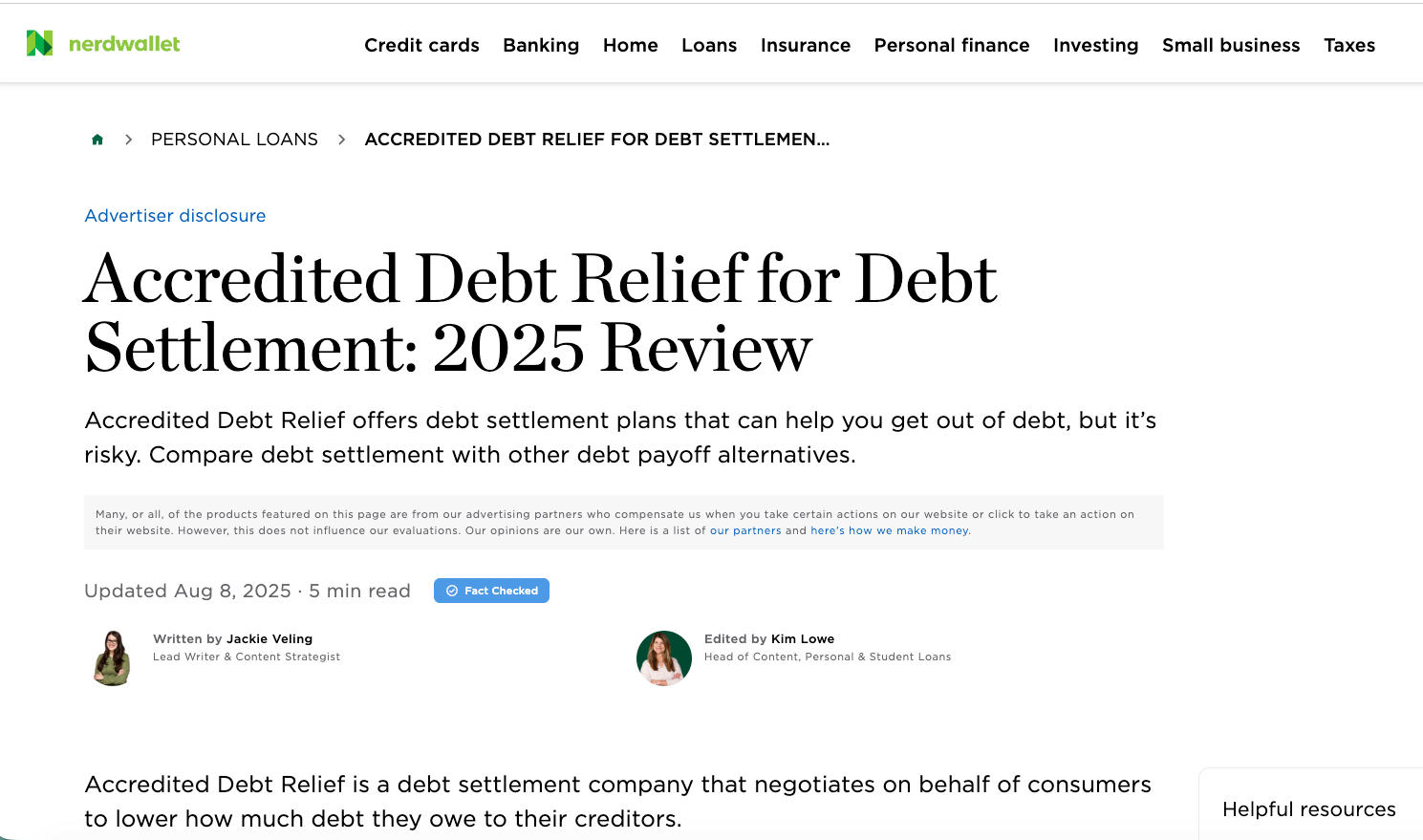
Not only had I unwillingly signed up for marketing communications from Nerdwallet’s debt consolidation partners, I was now on the mailing list of a company whose business Nerd editors called “risky” in the most recently updated review:
Look—I get it. Writing reviews and comparisons of companies and products that offer advertising or affiliate payouts is a tried and true way to tell a story about boring things like debt consolidation services.
But how can it be ethical for a company to redirect a potential first-time customer to a third-party company or product that the redirecting company does not recommend?
Here’s Where It Got Weird
I should have just moved on. But I couldn’t shake this digital intrusion, especially after looking more closely at the welcome email I got from Accredited Debt Relief.
Notice anything odd?
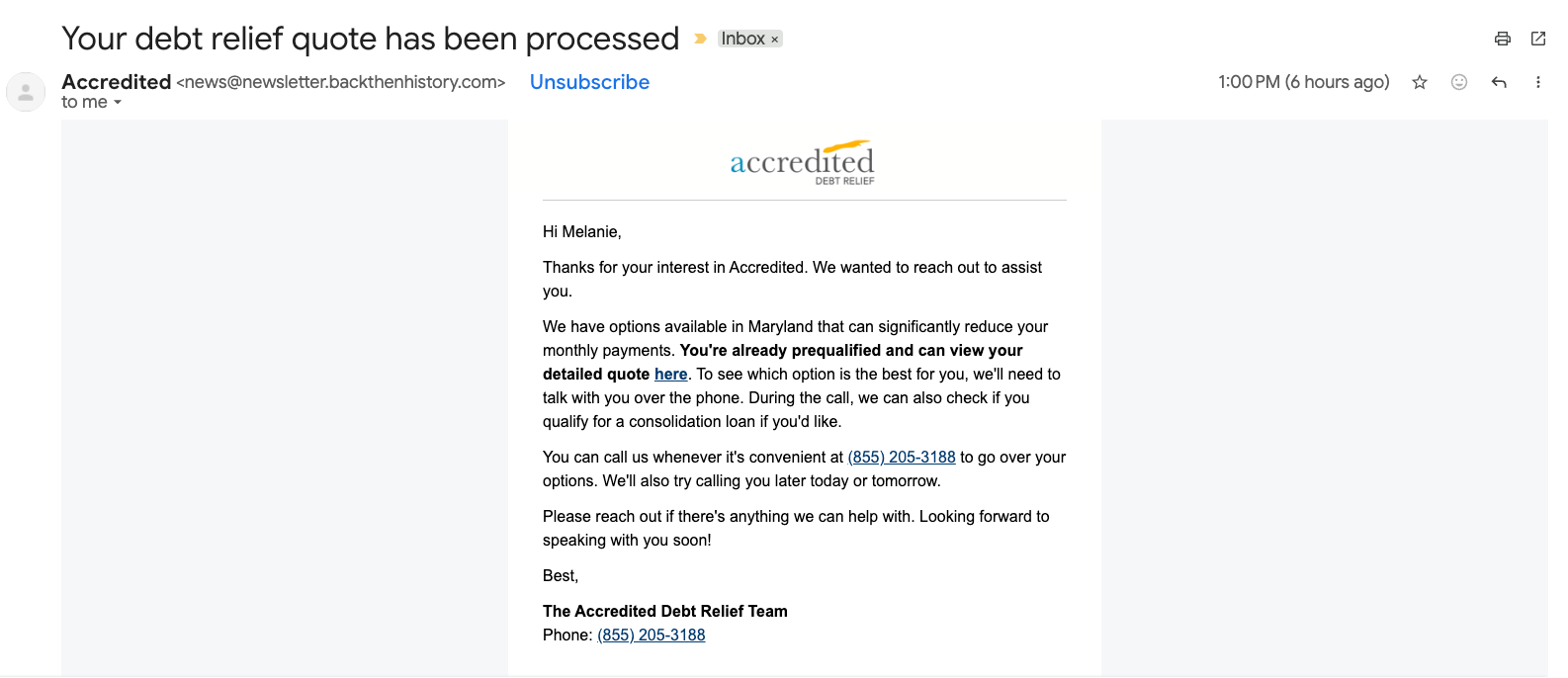
Look again at the return email address. Why doesn’t the domain match the name of the company?
My best guess is that the error occurred because someone copied a template and forgot to change the sender info and social media outlinks. Most likely, the same agency who handles newsletter sends for the Accredited Debt Relief Team also handles marketing for Backthenhistory.com.
If that’s the case, my apologies (and condolences) to the person(s) who created these emails. But I had to bring this egregious error into the light as it creates even more questions than it answers.
And just like that…AI slop takes over
But wait, there’s more! This being 2025, there’s also an AI angle.
As soon as I started looking around the backthenhistory website, I could see it was built on AI slop.
I used archive.org, aka the Wayback Machine, to examine the content on Backthenhistory.com, which had hundreds, maybe thousands, of pages that all followed the same naming convention and template.
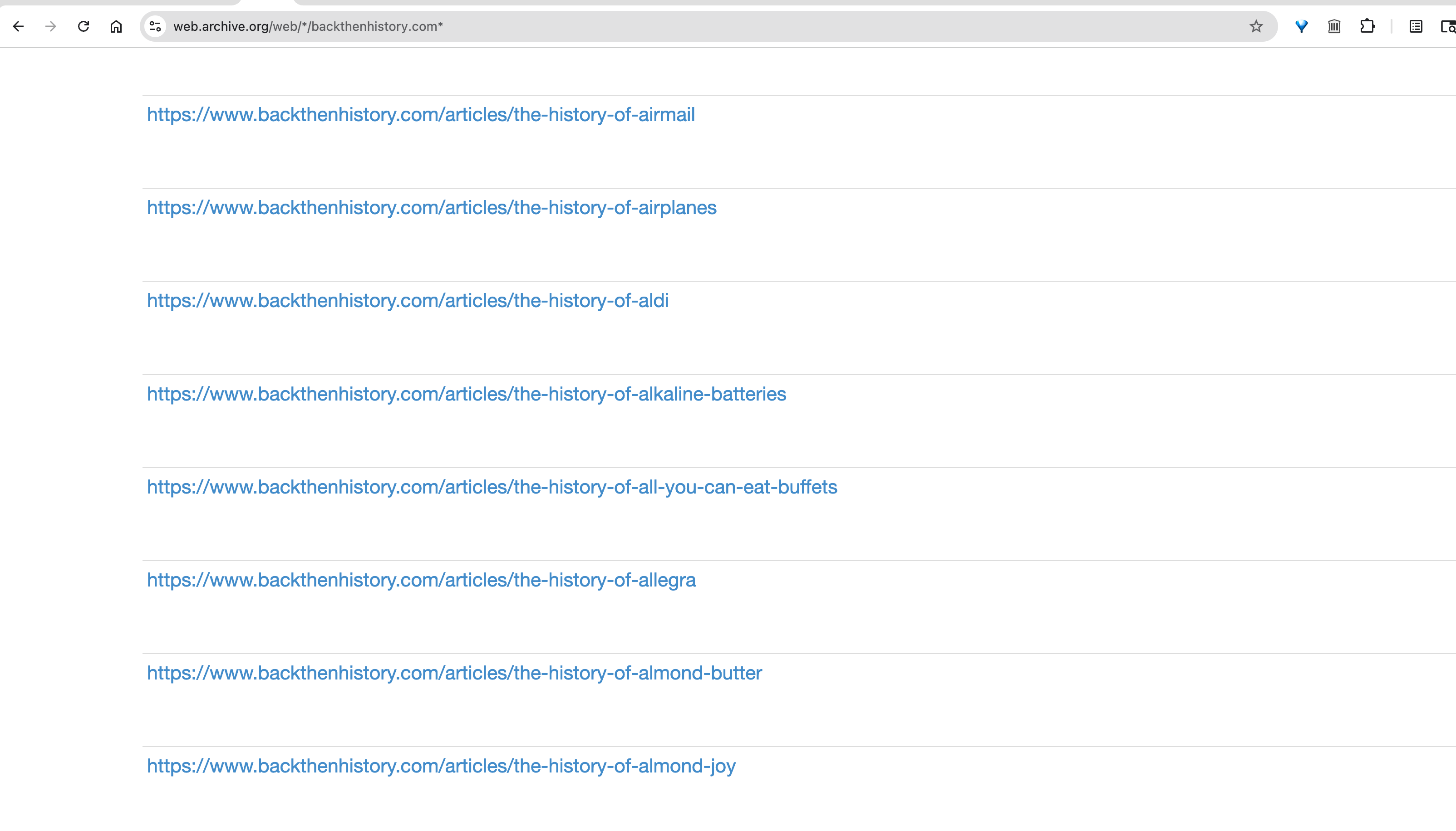
While these near-daily posts about the history of everything from A to Z look like fun posts written by a real author or authors, they feature zero citations and zero outbound links.
These things matter.
Friends and family have criticized me lately for lacking focus. No one seems to understand that I am focused—very focused—on shining a light on corruption and injustice, especially in areas familiar to me.
I wouldn’t be going to the trouble of pointing all of this out if it didn’t matter.
People make mistakes. Companies make mistakes. But little things add up.
Maybe you don’t care that a sign-up form redirects users to another website, but I do.
Maybe it’s no big deal that a financial services company put the email address and social media links of a content mill in its welcome email. It could’ve been a mistake. Although, the follow-up emails from ADR have all come from the backthenhistory.com email.
Maybe it’s no big deal that the company handling the customer outreach for ADR also sends out junk AI content.
And maybe AI content mills are no different than blogs, compiling and curating info that people are looking for.
But what happens when the AI becomes the source? BTH has already become a source on a number of websites, including on Wikipedia.
Even if it is possible to restrict large language models from engaging in fabrication, should we use them to generate Web content? This would make sense only if our goal is to repackage information that’s already available on the Web. Some companies exist to do just that—we usually call them content mills. Perhaps the blurriness of large language models will be useful to them, as a way of avoiding copyright infringement. Generally speaking, though, I’d say that anything that’s good for content mills is not good for people searching for information. The rise of this type of repackaging is what makes it harder for us to find what we’re looking for online right now; the more that text generated by large language models gets published on the Web, the more the Web becomes a blurrier version of itself. —ChatGPT Is a Blurry JPEG of the Web, The New Yorker

Everything that’s happening online right now—from tiny tricks to capture your data to AI stealing intellectual property, reminds me of a quote I found while researching this post:
“It’s just a waste,” he says, “when people don’t find the right answer—and no one is benefiting. Not the person who’s fumbling around, not really any financial institution. Everyone loses, and it’s stupid, and the internet should have fixed this a long time ago.” —The $520 Million Company That’s Solving All Your Financial Needs, Inc. Magazine, February 2016
Yes, it really is a waste that I can’t find what I’m looking for. But I’m not going to stop being observant.